The $2.6 Billion Case for Shutting Up


Listen to the Dumbify Podcast on Spotify or Apple.
👋 Hey dumdums,
Wall Street has a type. Fast talkers, big screens, complex models, 80-hour weeks fueled by conviction, cold brew and an Adderall addiction. That's what "smart money" looks like. Charlie Munger looked at all of it and thought, "That's dumb."
Meanwhile, Munger's playbook looked like this. Think backwards. Say nothing. Avoid stuff. He sounded like a guy giving life advice from a porch rocker, and the entire financial establishment thought he was oversimplifying. He died at 99 worth $2.6 billion.
If this newsletter is about getting smarter by thinking dumber, then Charlie Munger is our patron saint. Today we're canonizing him with three of his most eye-roll-worthy sayings, and why each one is quietly genius.
The Dumb Lens
Charlie Munger built one of the greatest investment track records in history by doing things that made credentialed professionals wince. "Invert, always invert." "I have nothing to add." "All I want to know is where I'm going to die, so I'll never go there."
Every single one of his backward thinking "Mungerisms" made him billions while the "smart" people were blowing up their portfolios with leverage and complexity.
That's the Munger paradox. What the experts called smart (more analysis, more opinions, more action) he called stupid. And what he did instead (subtract, shut up, stay away) looked so idiotic at first that people thought he was joking. They literally laughed at him during shareholder meetings. He was worth more than all of them combined.
"It is remarkable how much long-term advantage people like us have gotten by trying to be consistently not stupid, instead of trying to be very intelligent."
Every MBA program teaches you to chase alpha. Munger made billions chasing the absence of what he saw as stupidity. And if that's not the dumbest-sounding smart strategy ever invented, I don't know what is.

"Invert, Always Invert" (a.k.a. Think Backwards, Win Forwards)
Munger borrowed this from the mathematician Carl Jacobi, who solved hard problems by flipping them around. Instead of asking "How do I build a great portfolio?" Munger asked "What would guarantee a terrible portfolio?" Then he just... didn't do those things. Concentrated positions in things he didn't understand? Out. Chasing hot tips? Out. High fees? Out.
This sounds almost insultingly simple. But Berkshire Hathaway's entire approach to capital allocation was essentially a giant checklist of what NOT to do. While other investors were trying to find the next big thing, Munger was crossing off the next big disaster. The result over 50+ years with Buffett was a compounded annual return that made most hedge funds look like savings accounts.
Farnam Street's deep dive on inversion as a mental model
"I Have Nothing to Add" (a.k.a. Silence as Strategy)
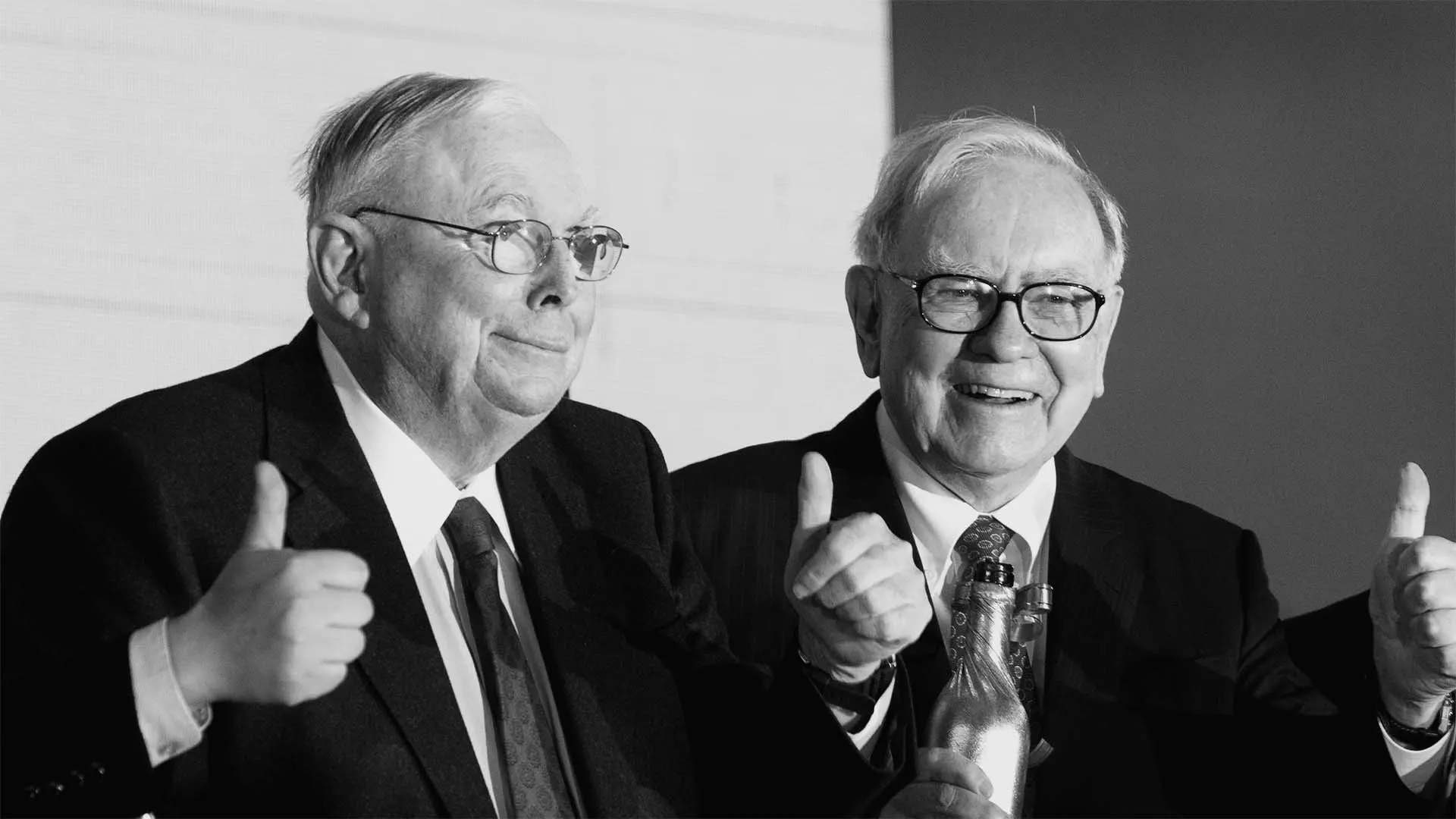
At Berkshire Hathaway's annual meetings, Warren Buffett would speak for paragraphs. Then the mic would go to Munger. And more often than anyone expected, his response was five words. "I have nothing to add." Audiences laughed every time. But Munger was dead serious.
He believed that most speech in business settings is performative. People talk to seem smart, to justify their seat at the table, to fill silence that makes them nervous. Munger only opened his mouth when he could change the direction of a conversation. The rest of the time, he was busy doing something radically underrated in the 21st century. Listening. In an era where everyone is optimizing their "personal brand" and "thought leadership," a billionaire repeatedly telling rooms full of people he had nothing to say is almost performance art.
CNBC's retrospective on Munger's life and legendary one-liners

"All I Want to Know Is Where I'm Going to Die" (a.k.a. Win by Not Losing)
This is Munger's most quoted line and it sounds like something stitched onto a pillow at a weird Airbnb. But it contains his entire philosophy of risk management. Instead of modeling what success looks like, map out what catastrophe looks like. Then build a very wide fence around it.
Munger and Buffett famously avoided the dot-com bubble, the worst of 2008's derivative exposure, and countless "sure thing" investments that vaporized other funds. They didn't have a crystal ball. They had a kill list of situations they would never walk into. Munger called this "the one-legged man in an ass-kicking contest" problem. If the odds are structurally terrible, no amount of skill saves you. So don't show up. It's avoidance dressed up as strategy, and it outperformed almost everyone for half a century.
Farnam Street's collection of Munger's mental models
What Does Science Have to Say?
Munger's instinct to avoid losses rather than chase gains has serious academic backing. Terrance Odean's 1998 study on the disposition effect found that individual investors consistently sell winning stocks too early and hold losing ones too long. The exact pattern Munger's inversion approach is designed to prevent.
And Nassim Taleb's concept of via negativa formalizes what Munger practiced intuitively. Improvement by removal (subtracting errors, bad habits, toxic exposures) tends to be more robust than improvement by addition. Your doctor telling you to stop eating garbage will probably do more for your health than any supplement stack on TikTok.
Dumb Word of the Day
apophasis (ah-PAH-fah-sis) noun
The rhetorical device of bringing something up by claiming you won't mention it. "I'm not going to talk about my opponent's criminal record" is classic apophasis.
This is the perfect word for today because Munger's whole philosophy was a kind of intellectual apophasis. He defined his brilliance by loudly pointing at everything he refused to do. His wisdom lived in the negative space.
Let's use it in a sentence: "My investment strategy is pure apophasis. I won't mention crypto, meme stocks, or that time I bought $400 of Dogecoin at the peak, but somehow you now know all three."

The Munger Inversion Challenge
Pick one goal you're working on right now. Could be a project, a fitness thing, a relationship, whatever. Now flip it. Instead of asking "How do I make this succeed?" write down three ways you could absolutely guarantee it fails.
Be specific and honest. "I could check my phone every four minutes during deep work" counts. "I could keep saying yes to every meeting that should've been an email" counts. "I could keep dating people who describe themselves as 'fluent in sarcasm'" also counts.
Now look at your list. How many of those failure-guaranteed behaviors are you already doing? Stop those. That's it. That's the whole Munger method. Genius through subtraction.
Thanks for getting dumb with me today
Remember, you don't need to be the smartest person in the room. You just need to be the one who isn't doing the obviously dumb thing. Charlie would have nothing to add.
David 🎉