You’re Not a Disaster. You May Just Have a Milieu Problem.


Listen to the Dumbify Podcast on Spotify or Apple.
👋 Hey dumdums,
My friend told me a story last week that I haven't stopped thinking about. It's about a car factory in Northern California in the 1980s where the bars were fullest at 7 AM. Not because of early-bird drink specials. Because the workers were getting hammered before their shifts. Sometimes so few people showed up they couldn't even start the assembly line. Management had tried everything. New rules. New incentives. New threats. Nothing worked.
Then Toyota walked in and didn't change a single person on the payroll. And within months, that factory was producing cars twice as fast with 30% better quality.
Same humans. Completely different results. Which raises an uncomfortable question about every time you've blamed a person for a problem.
The Dumb Lens
Every management instinct says the same thing when performance is bad. Fix the people. Coach them, train them, replace them, threaten them. The entire HR industrial complex runs on this assumption. Bad results mean bad people.
Toyota looked at the same drunken, absentee, "toxic" workforce that GM had written off as hopeless and said something that sounds profoundly stupid. The people are fine. The system is broken.
They didn't fire anyone. They didn't screen for better hires. They redesigned the environment those people worked inside. Gave them ownership. Gave them thinking work instead of robot work. Gave them a cord to pull that would stop the entire production line if they spotted a problem or had an idea.
"You don't fix humans by yelling at them harder. You fix the container they're operating in."
This is the dumb move that makes every traditional manager twitch. Stop fixing your people. They were never the problem.
The Factory That Turned Drunks Into Engineers
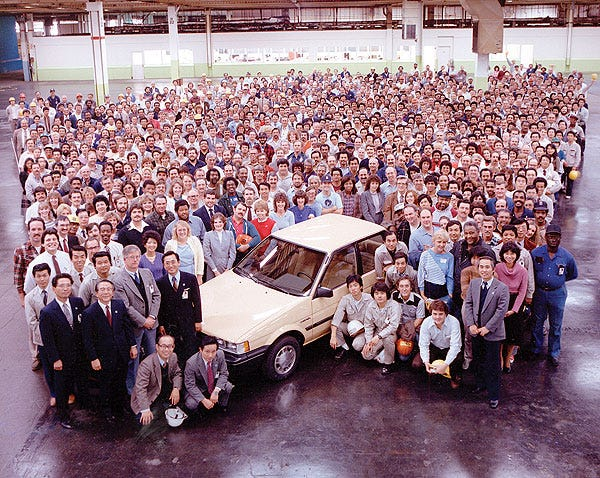
In 1984, GM gave Toyota its worst factory. NUMMI, in Fremont, California, was so dysfunctional that workers would sabotage cars on the line. They'd leave bottles inside door panels. GM shut it down in 1982 because it was unsalvageable. Toyota reopened it with the same workforce and flew everyone to Japan for two weeks. They taught them the Toyota Production System, where every worker was expected to think, not just screw. Every station had an andon cord. Pull it when you spot a problem. Pull it when you have an idea. Your chosen music plays across the factory floor. A manager comes over. Not to punish you. To listen. There's video of workers leaving that training in tears, saying it was the first time they'd ever been treated like human beings. Within months, productivity doubled and defects dropped by 30%.

GM Photographed the Answer and Still Went Bankrupt
The funniest part of the NUMMI story is what GM did next. They sent managers to photograph every inch of the factory. Paint that thing yellow. Hang that cord there. Copy the layout exactly. They replicated the physical setup in their own plants and got zero results. Because they copied the scenery and missed the play. The andon cord is worthless if pulling it gets you fired. A suggestion box is decoration if nobody reads it. GM had a front-row seat to the answer for over twenty years. They filed for bankruptcy in 2009.

The Hospital That Stopped Blaming Nurses
Virginia Mason Medical Center in Seattle had a medication error problem. The instinct was classic. Retrain the nurses. Add more checklists. Punish mistakes. Instead, they borrowed Toyota's production system (yes, literally Toyota's) and redesigned how medications were stored, labeled, and delivered. They stopped asking "who screwed up?" and started asking "what in this process made screwing up easy?" Medication errors dropped by 73%. Same nurses. Same hands. Different system.

Why Do We Do This?
Psychologists have a name for our obsession with blaming people instead of systems. It's called the Fundamental Attribution Error. We see someone fail and assume it's a character flaw. We almost never consider the situation they're operating in.
W. Edwards Deming, the statistician who basically taught Japan how to manufacture after WWII, put a number on it. He said 94% of problems belong to the system, not the individual. Ninety-four percent. That means almost every time you blame a person, you're wrong.
And Philip Zimbardo's famous (and controversial) Stanford Prison Experiment showed how quickly "good" people become cruel when placed in a system that rewards cruelty. The container shapes the behavior. Every time.
Dumb Word of the Day
milieu (mil-YOO) noun. A person's social environment or surroundings. From French, literally meaning "middle place." It's the perfect word for today because it puts the spotlight exactly where Toyota put it. Not on the person standing in the middle of the room, but on the room itself.
Let's use it in a sentence: "My therapist says I'm not lazy, I just have a milieu problem, which is a very expensive way to say my couch faces the TV."

The Blame Flip
Pick one thing that's frustrating you right now. A habit you can't stick to. A coworker who keeps dropping the ball. A project that's stalling. Now instead of asking "what's wrong with this person?" (including if that person is you), ask "what's wrong with this system?"
Can't get to the gym? Maybe the problem is that your gym is 30 minutes away, not that you lack discipline. Team keeps missing deadlines? Maybe the problem is the deadline process, not the team. Write down the system-level fix. Just one. Try it this week. You might be surprised how fast "broken people" start working when you fix the container they're standing in.
Thanks for getting dumb with me today
Remember, you're not a mess. You're just standing in a messy system. (Okay, maybe a little of both.)
David 🎉