This Empire Runs on Nonsense

Listen to the Dumbify Podcast on Spotify or Apple.
👋 Hey dumdums,
The most unassuming person I've ever worked with runs the most chaotic company on the internet. Gabe Whaley speaks softly, thinks carefully, and once sold 666 pairs of blood-filled Satan sneakers while racing a federal restraining order. He also sold a laptop full of computer viruses for $1.3 million, built tax software that makes you date anime characters before you can file your returns, and put a paintball gun on a robot dog so strangers could shoot it at art. His company is called MSCHF (pronounced "Mischief"), it's worth over $200 million, and their entire strategy is having no strategy at all.

The Dumb Lens
Everything you've been taught about building a company says, "know your customer, solve a real problem, build trust through consistency, explain your value proposition clearly." MSCHF does none of this. They don't know who buys their stuff. They create problems instead of solving them. They release a rubber chicken bong one month and a microscopic Louis Vuitton handbag the next. Their founder, a West Point dropout named Gabriel Whaley, once described his creative process like "doing drugs."
And yet. Every product sells out. Every lawsuit becomes free advertising. Every outraged corporation accidentally amplifies the thing it's trying to kill.
Pointlessness, it turns out, is a business model. In a market where every brand is A/B testing and focus-grouping its way to the exact same bland middle, the contrarian move is to be genuinely, unapologetically inexplicable. Confusion creates connection.
❝ In a world optimizing for sense, nonsense is the scarcest resource. ❞
Satan Called, He Wants His Shoes Back
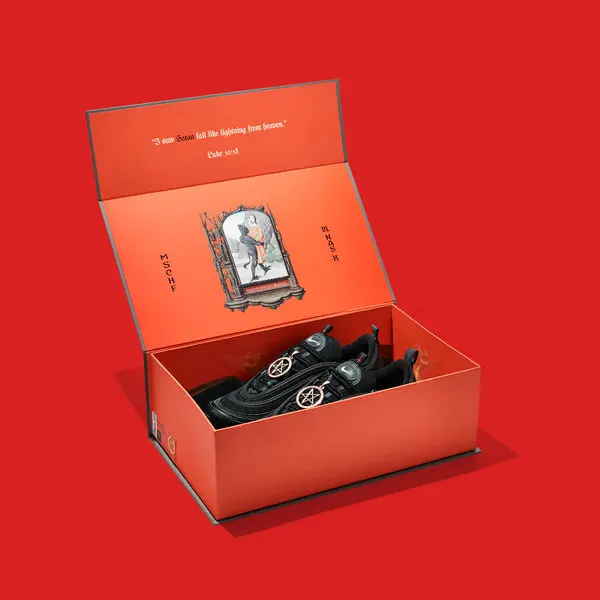
In March 2021, MSCHF released 666 pairs of modified Nike Air Max 97s, each containing a drop of real human blood mixed with red ink in the sole, a bronze pentagram, and an inverted cross. They sold out in under 60 seconds at $1,018 a pair. Nike sued for trademark infringement within hours. A federal judge issued a temporary restraining order. MSCHF's team pulled an all-nighter shipping every pair before the court could stop them. And the beautiful part? Two years earlier, MSCHF had done the exact same thing with "Jesus Shoes" filled with holy water from the Jordan River. Nike didn't sue over those. Jesus was good for the brand. Satan was not. The lawsuit became the product. Every news story showed the shoes. They eventually settled, but secondary market prices went through the roof.

The Robot Dog They Killed (And It Still Won)
MSCHF spent $74,500 on a Boston Dynamics Spot robot, mounted a paintball gun on it, put it in an art gallery, and let random internet users control it via an app. Boston Dynamics was furious. They condemned the project, then remotely disabled the robot through an undisclosed backdoor. Think about that. You buy something at full price, and the company can still reach inside and turn it off. MSCHF's response? They renamed the piece from "Spot's Rampage" to "Spot's Revenge" and exhibited the dead robot as commentary on corporate control over consumer products. The obstacle became the art.

Giant Cartoon Boots That Broke Fashion
In February 2023, MSCHF released the Big Red Boots. Giant, cartoonish, bright red, made of plasticky rubber. They look like Astro Boy's footwear. They're uncomfortable. They cost $350. They sold out in minutes. Within days, resale prices topped $2,000. Lil Wayne and Diplo wore them to NBA games. The hashtag generated over 25 million views on TikTok. There was no influencer campaign. No celebrity partnership. Just giant stupid red boots that made no practical sense, which is exactly why they worked. In an economy where every brand tries to seem effortlessly cool, MSCHF made something effortfully ridiculous.
What Does Science Say?
Wharton professor Jonah Berger identified six factors that make things go viral (he calls them STEPPS). MSCHF hits five out of six on basically everything they drop. The only one they skip is practical value, because why would you add that.
But Berger's model might actually miss the deeper mechanism. Researchers have found that unexpected stimuli trigger deeper encoding in the brain. When something violates your expectations, like shoes with blood in them or a handbag smaller than a grain of salt, your brain spends more processing power on it. You remember it longer. You talk about it more. That moment of "Wait, what?" is the strongest sharing trigger there is. Confusion, not clarity, is the viral engine.
Pataphysics (pat-uh-FIZ-iks) noun. A satirical philosophy invented by French writer Alfred Jarry in 1893, defined as "the science of imaginary solutions." Where physics studies the laws governing the universe and metaphysics studies the principles behind those laws, pataphysics studies the stuff that shouldn't exist but does anyway. Confirmed real by Merriam-Webster, which defines it as "intricate and whimsical nonsense intended as a parody of science." MSCHF is basically a pataphysics lab with a shipping department.
Let's use it in a sentence: "I used to think my career required strategy and planning, but after watching MSCHF sell blood sneakers for a thousand bucks, I've decided to take a more pataphysical approach. Specifically, I'm starting a company that sells bottled nothing and seeing what happens."

I don't know if MSCHF's playbook is replicable. I'm not sure they know either. That might be the point.
But I do think there's something here for the rest of us — something about the courage to be inexplicable. To make the thing that doesn't fit. To resist the urge to explain yourself before anyone even asks.
The world is full of people with strategies. It might be running low on people who are genuinely, specifically, unapologetically weird.

This week, try the "Unexplainability Audit."
Take something you're working on right now. A project, a presentation, even an email you've been drafting. Ask yourself if you could explain it in one sentence to a stranger in an elevator. If the answer is yes, good, that's what normal people do. Now ask yourself what would happen if you added one element that made someone say, "Wait, what?" Not confusing for confusion's sake, but a detail that doesn't quite fit, a choice that seems arbitrary but might actually be interesting. Bonus points if someone asks, "Why did you do that?" and you genuinely don't have a good answer. You might be onto something.
Thanks for getting dumb with me today.
Remember, the only strategy is having no strategy. The experts are still trying to figure out what just happened. And somewhere in Brooklyn, a group of weirdos is already shipping the next thing that shouldn't exist.
David 🎉